Showing posts with label FDA. Show all posts

Monday, January 7, 2013

on my mind monday 01.07.13


It's never the same two weeks in a row.  A collection of what I find interesting in the world of food, nutrition, and holistic health.  Here's what's on my mind.

FDA begins implementing sweeping food-safety law - It's about time.  While I do believe that we need to have better measures in place to protect the safety of our food I will also say that I'm concerned that many larger food producers will still push for self-monitoring.  And I'm not convinced that the government is able to properly monitor our food system.  But changes are coming and I remain hopeful that this will be a positive thing overall.

Washington State eyes labeling GMO - Ready to be filed this week, it's an initiative to label GMO foods.  Also Prop 37 did not pass it opened the eyes of a lot of consumers and got them thinking about what's really in their food.  With around more than 100,000 more signatures than required to send the initiative to the Legislature this measure should be certified by the end of the month, starting the legal process to bring it in front of the voters.  I'm looking forward to watching this and hope that Washington can become the first state to make this happen.

Another hospital banning McDonald's - It's about time.

Gazpacho could help lower blood pressure -  given that it's made from whole foods which are known to have a wide variety of health benefits I wouldn't be surprised if further study proves this to be true.  In any event it's certainly a fabulous way to get a healthy serving of vegetables.  Here's my favorite gazpacho recipe for those willing to drink cold soup during the cold months.

B vitamins may boost colorectal health - B vitamins are so important to our health across a spectrum that includes stress, sleep, the immune system and more.  Now it turns out that they may have a benefit for colorectal health as well.  Studies need to continue however in the meantime it never hurts to continue to eat foods rich in B vitamins.  High levels of B6 can be found in tuna, beef and poultry.  Riboflavin rich foods include venison (also a good source of B6) and yogurt.

Dandy Blend - Not a news article, but definitely something that is on my mind.  With the colder temperatures (yes even in Texas), I've begun to drink more Dandy Blend.  It's a delicious beverage that is an excellent substitute for coffee.  Rich and full bodied I make mine with goat's milk and sometimes for a little treat I top it off with a teaspoon of coconut milk ice cream.  Why is it on my mind?  I met with my editor, Donna, yesterday and made a cup for her.  She had never had it before and loved it.  She said, "This is my new favorite drink."  So I wanted to share, maybe it's your new favorite too.

Here's a fun video from Joy Bauer with information about hot sauce


Don't forget to like The Pantry Principle to get
news and information about what's really in your food.

photo: mconnors

Wednesday, June 20, 2012

bubble gum flavored apples anyone?

fake apples | photo:  LeemanS
One of my readers, sent in this picture and comment/question about these apples.

"We came across these apples at Stop & Shop here in town. We could not believe our eyes when we saw flavored apples!! I told my husband to take a pic to send to you because I wasn't sure you would believe me when I tell you that they had bubblegum flavored apples. I believe there were four flavors total to choose from. 


I'm curious what your thoughts are. I walked away all kinds of confused. Was this an attempt to help kids with poor eating habits cross over the healthy eating or the other way around? How exactly did they alter this apple to make it flavored? And of course the obvious...yet another example of FAKE food.
grapples | photo: Qrd2006

Oh and as you can see it's was placed right next to the apples and the packaging says ready to eat snack.  What's so difficult about preparing an apple for eating?  hmmm you wash it?!?!"

Good eye, and good thinking.  This is very similar to something I just saw in my local grocery store called grapples.  Research indicates that the flavoring comes from "natural" (read possible MSG ingredients) and artificial flavoring. It seems that the apples are marinated for several days in an undoubtedly chemical concoction which allows the apple to soak up the flavor.  This process has apparently been approved by the FDA.

The Grapple company website assures the consumer that the product has not been genetically modified and there are no added sugars or calories.  Unfortunately there is a huge chemical load, not just from the flavorings, but one assumes these are not organic apples and therefore potentially high in pesticide residue.

The Crazy Apple company website says they can't tell you how they do it but I assume it's the same sort of process.  They do however assure you that their apples are gluten free (duh!), dairy free (again, duh!), and contain no soy or nuts.

I believe this is seen as a way to market apples to kids but I'm not really sure why this sort of adulteration is seen as a positive.  Since apples by themselves are sweet, crunchy, and tasty I'm not sure what the appeal is here.  Unfortunately I see this as a big step backwards as items like these further dull the taste buds to what food should taste like.

Update:  It turns out these apples are being spotted all over the place and most of you are not happy about it.  My friend Adrienne says, "If you want a grape flavored apple take a slice of apple and some grapes.  Eat them together.  It's a party in your mouth!"  Good advice.


Monday, May 28, 2012

on my mind monday 5.28.12

news | photo: mconnors
It's never the same two weeks in a row.  A collection of what I find interesting regarding food, nutrition, and holistic.  Read what's on my mind.

Flame Retardants Could Affect Our Bodies For Generations - The more we pollute our environment, sadly, the more we pollute our bodies.  And the effect is cumulative (and in some cases exponential) from one generation to the next.  In her book Origins: How the Nine Months Before Birth Shape The Rest Of Our Lives author Annie Murphy Paul talks about how the placental barrier is not as impermeable and protective as we had previously thought.  And with the growing number of chemicals in our environment our bodies are taxed even more.  As the article highlights, there are a growing number of studies that show the results affect DNA and last for generations.  This is a very scary issue and one that needs to garner more attention both from the public and from industry.

The Garden Summer - a new twist in reality t.v., the main person invited four other people to join her in living on a farm.  None of them had any experience.  The documentary highlights their journey.  I would be interested in seeing the movie although I'm not sure how wide the distribution will be.  I envision this as a modern day version of Frontier House, a PBS series where several families were given a little training and then put into a setting reminiscent of the late 1800's.  It's a sobering thought, however, that so many of us no longer know how to raise our own food and how to live a more environmentally connected life.

Sunflowers to clean radioactive soil in Japan - The fallout from Fukushima is serious and likely to last for generations.  I was glad to hear that phytoremediation (the use of plants to clean up the soil) was an option being encouraged in this disaster.  Apparently this method was used after the Chernobyl accident back in the late 1980's.  In addition to sunflowers other plants such as mustard, alfalfa, fennel, and barley are effective choices.  One important issue is the fact that plants used this way cannot be consumed due to the high level of heavy metals they extract from the soil.  I am a little puzzled that Japan is asking local citizens to grow sunflowers and then plans to harvest the seeds and plant them at Fukushima.  To my mind it would make more sense to ask for donations of sunflower seeds from around the world and the phytoremediation could be started one growing year earlier.  Research on the internet, however, failed to turn up an address where sunflowers seeds could be sent.

Tainted Spinach Detected By A Program Budget Cuts Will Axe - Given the increasing number of food recalls and contamination issues I am very surprised to see that this program will be going away.  The governmental agencies already do a poor job at monitoring the food supply, I have to believe this will only make the situation worse.  The best solution in this case is to consider shopping more locally and get to know your farmer.  Know where your food comes from and how it gets to you.


Composting is wonderful; it's almost magical how you can take leftover coffee grounds, egg shells, potato peels, lawn clippings and other green matter and turn it into a high quality dirt so your garden will grow better.  We've finally discovered (after three prior attempts) how to keep the dogs out of the compost bin (really they're pigs in disguise).  An off-the-ground tumble style container.  Locked behind a gate.  We're finally starting to generate enough decent compost to be able to use it in the garden and that's a great thing.


What I'm reading:

Savor by Thich Nhat Han This is a book incorporating information about nutrition with the practice of mindfulness as applied to weight, health, and our relationship with food.  An interesting blend of science and spiritual practice I am enjoying it so far.\

disclaimer: cmp.ly/5

Tuesday, May 22, 2012

another helping of meat glue?

meat glue | photo: the bovine
First it was pink slime. And no matter what anyone says I do not believe that is something that should be considered fit for human consumption. But I've already written about that.

Now we have "meat glue." Approved for human consumption by the FDA, allowed in Canada, and defended by the American Meat Institute it is made from something called transglutaminase.   Used to put together pieces of meat, this powder can be used to make them look like a better cut of meat. It is also used to improve the texture of certain foods.

According to my research, transglutaminase, or meat glue, can be found in processed meat and other foods such as imitation crabmeat, fish products, and ham.  However it's not just used for meat and can also be used in those food products where a gelling process is needed such as cheeses, jellies, yogurts, or frozen desserts.  Meat glue is made utilizing Streptoverticillium mobaraense.  What is S. mobaraense?  Apparently it's a micro-organism that secretes transglutaminase.  I'm not exactly clear on how the process works but that is the condensed version.  Anyone who would like to dig through the more extensive explanation can find it at the American Society for Microbiology.

One complaint is that producers may be selling cheaper cuts of meat as a higher grade because it looks like something it's not. This is a valid point; it would definitely be a reason to get upset for being overcharged by a producer making cheap cuts of meat pieces look like a very expensive filet.  Searching the web it appears that one area where this may happen is buffet restaurant settings.  Those places where you can get as much filet mignon as you want for one low low price.  Apparently there's a reason that price is so low; it may not be what you think it is.  I want to point out, in all fairness, that there is a big kerfluffle about this issue but so far I have not found any legal cases where a producer or seller is being charged with this practice.

The health challenge is potentially different.  The use of meat glue means that there could be a higher risk for bacterial contamination due to the increased number of surfaces.  The more surfaces, the more area for bacteria to live.  For those consumers who like their meat less well done this creates more risk.  If the meat is not fully cooked (i.e., rare rather than well done) the joined parts may not reach a temperature capable of killing bacteria. With the new meat nutrition labeling requirement we should be able to see if transglutaminase is used on the meat at the grocery store.  However, I have yet to see a single package that is using this new labeling.

Made by Ajinomoto, the same company that makes MSG, I would like to point to a few other health issues that concern me.  The picture above is a packet of meat glue powder.  It comes with a dose of maltodextrin and sodium caseinate.  Maltodextrin is corn based so there is probably some GMO exposure as the use of organic corn would not make financial sense.  Sodium caseinate is a milk protein  and according to Truth In Labeling always has free glutamic acid making it a form of MSG.  Additionally there is a possibility that the milk used to obtain the protein has rBGH in it, a hormone that makes cows give more milk.  That's a whole blog post in and of itself, but the bottom line is you don't want to consume rBGH.  The issue at hand is the possible reaction to corn or dairy that could be brought about by ingestion of meat in those with high level food sensitivities.

How to avoid meat glue?  That appears to be a little trickier.  I have been extra diligent about reading labels at the grocery store lately and have not seen transglutaminase listed on any ingredient labels.  For meat products I believe the answer to be the purchase of organic meat or to buy from a trusted source.  Kosher meat is not exempt from the use of meat glue as there is a kosher version available.  Otherwise, until meat labeling actually happens, and unless they include transglutaminase on the label, you won't know.  For other products I don't have an answer at the moment.  Purchasing organic dairy, which I recommend anyway, is a good option.  But until this product is properly labeled or removed from the food supply we may not know if we are ingesting it.


Monday, January 30, 2012

on my mind monday 1.30.12

newspaper | photo: mconnors
Once again, it's time to see what's on my mind.  These are the articles that have come across my desk and that I am interested in this week.

My Subversive (garden) Plot - Roger Doiron's funny TEDx talk about gardening and food.  While it's funny there's also a message.  He talks about how we are going to feed people and how we need to grow more food to keep up with the growing population.  But we need to do so with less. Less oil, less water, less farmland, less genetic diversity, and so on.  I highly encourage you to watch the clip, it's worth the time.

Local Food Sovereignty Being Challenged in Maine - Roger's talk, above, lead to to search for food sovereignty.  I discovered that in some ways Maine is ahead of the curve.  Hey, they voted in many towns for food sovereignty - allowing cottage food industries to come into existence and grow.  But then there's the challenge that comes up from one farmer who is being challenged.  I am continually amazed at how major corporations produce harmful food, salmonella laden peanut butter, the massive egg recall of 2010, and others.  There appears to not only be very little consequence for these companies for knowingly producing bad food, but the government is increasingly going after small producers whose food is not contaminated or harmful.  Their primary crime seems to be that they are small producers.  Doesn't make sense to me.

Big Pharma Is Putting Microchips in Drugs - This article disturbs me on a lot of different levels.  First of all, I don't want to be microchipped.  For any reason.  Second of all, I'm not convinced that the data collected from this will be able to take into account bio-individual response to the medication or to other lifestyle issues.  I see this as a potential gateway to the doctor deciding that based on your results you need more medication.  Thirdly, I think it has the potential to go massively awry.  We are not meant to eat or ingest microchips.  One of the thoughts that occurs to me is that although right now we can know if we have it because the chip transmits to a patch on the skin, what if they find another way for the chip to transmit.  Then we won't know if this is in our medications.  Just not a good idea.

Why Woman Should Stop Their Cholesterol Lowering Medication - I was stunned to learn that for post-menopausal women, taking statins can increase their risk of diabetes by as much as 48%.  That's an enormous risk.  Cholesterol is important to our health.  It comes from two sources, either we make it naturally in our liver, or we ingest it from our food.  In the rush to reduce cholesterol many of us lose sight of (or are unaware) that cholesterol that is too low is also unhealthy.  Studies done in 2000 show that low cholesterol (below 160 mg/dl) can cause anxiety and depression in otherwise healthy women.  And other studies show that reduced cholesterol (and saturated fats in the diet) can increase the risk of hemorrhagic stroke.

    All of the above indicates a need to look carefully at your diet, your cholesterol intake and cholesterol levels before taking statins.  As a side note it is important to know that if you are taking statins you would do well to also take CoQ10.  Statins deplete CoQ10 from your body.  Adding it to your supplemental routine can help prevent or reduce some muscle problems that can go along with statin use.  


Monday, January 23, 2012

on my mind monday

newspaper | photo: mconnors
It's Monday and these are the news articles that have caught my attention from around the web:

A look at the $175 in your compost - That's how much many Americans throw our per month in food.  Most of it probably goes straight to the landfill not to a compost pile.  Wherever it goes, however, is a huge waste of food and resources.  We work hard at our house to make good use of leftovers, to plan what I call sequential eating, and menu planning.  This idea of not wasting food ties in with what Jonathan Bloom has been promoting for a while through his book, American Wasteland, and his Wasted Food blog.  Given the rising cost of food, it makes even more sense to think about what we're eating and how much we're buying.

Walnuts Are Drugs - Says FDA - seriously?  This is just ridiculous.  There are large numbers of scientific studies showing the health benefits of walnuts but apparently this is not good enough for the FDA.  It kind of makes me wonder how oats managed to get their approval for their ability to lower cholesterol (which they do.  There are studies to this effect and yet oat producers are not being told they cannot use those studies).  I have no problem with stopping unvalidated health claims, but where there is evidence that shows the healthful benefits why is the FDA stopping them?  Of course this is the same agency that told the cherry industry that they couldn't promote the healthful benefits of cherries, even with USDA funded studies that showed exactly what the producers were claiming.  Obviously there is a huge conflict of interest between food and drugs.

Fruits and Veggies Challenge - ever since reading last week about the sad fact that the USDA is not going to use the clever videos promoting fruit and vegetables they received in response to their contest, I have been working my way through watching the videos.  They're all good, one I like a lot is the Fruit Veggie Swag video.  I find it ridiculous that the USDA has received some wonderful replies that clearly promote eating more fruits and veggies and they won't use them.  I would much rather watch these than an over-hyped unhealthy fast food ad.

Just Label It - This link takes you to a video by Robert Kenner, the filmmaker who made Food Inc.  I am a huge proponent of food labeling for all sorts of reasons.  I am very much pro-label for GMO and believe we all have a right to know what's in our food.  The website also allows you to tell FDA Commissioner Hamburg how you feel about this issue.


disclosure: cmp.ly5

Friday, January 6, 2012

antibiotics update

caged chickens | photo: sioda
Just a few days ago I wrote about the FDA withdrawing legislation to mandate less use of antibiotics in the food supply.  Now it turns out that earlier this week they did issue some legislation limiting the use of one type of antibiotic, cephalosporins. This class of antibiotics is not given to animals directly in their feed but instead issued, usually, prior to slaughter.  The FDA is concerned that this type of antibiotic is so important for use in humans (especially in life-threatening cases such as meningitis) that over use in animals can potentially cause bacterial resistance, thereby limiting it's usefulness in humans.

Since cephalosporins are a "last resort" type of drug it's important that their effectiveness not be compromised by over-usage in the animal industry.  However the FDA does not completely ban the use of this class of antibiotics, merely limiting it instead.

My concern with all of this is that there is still far too much antibiotic usage in this country in animal production.  I'm not sure, and was unable to find numbers, how much this limit reduces the total antibiotic usage in the animal production industry.  But the latest numbers show more than 70%.  So I have to believe that this limit provides only a modest reduction.  It still means that the vast majority of antibiotics used in this country are used to allow producers to raise animals in inhumane, unhealthy, confined and condensed operations.  Where is the sense in that?  Where is the logic behind an agency that is presumably supposed to monitor and protect the food supply which instead kowtows to major corporations and their bottom line.  Where is our compassion as living, sentient beings, for those beings whose purpose is to be raised for food?

I find myself skeptical that this "limited use" will actually be limited and am now waiting for the headline that proclaims a new class of bacterial infection that has successfully overcome cephalosporins and is wreaking havoc in hospitals and medical settings across the country.  In the meantime I continue to look for and source the best quality, most humane meat sources available for my family and community.  I hope those of you who eat meat are able to do the same for yours.

Monday, January 2, 2012

you get your antibiotics where?

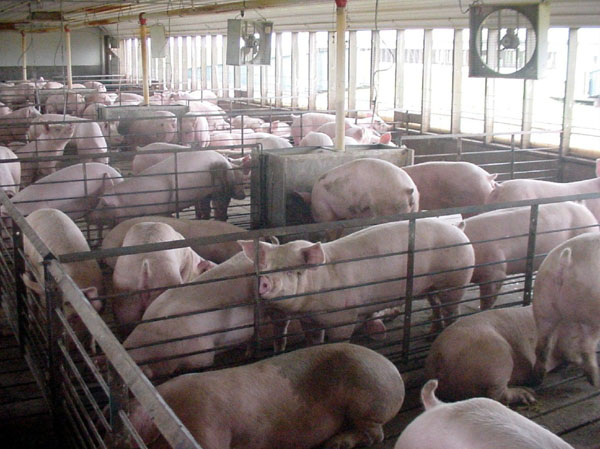
confined feeding lot - pigs | photo: Matthias M.
A recently published article shares that the FDA has once again failed to protect the public from corporate abuse.  Apparently in spite of it's own Guidance for Use (draft form published June 28, 2010) which was supposed to reduce the amount of antibiotics in the food chain, the FDA is now withdrawing legislation to mandate and reduce this usage.  I believe that this is because the FDA is too unwilling to do the right thing and would rather protect corporate interests (corporates need this overuse and abuse of antibiotics in order to be able to run their Confined Animal Feeding Operation (CAFO) or factory farms.

It is a disturbing fact that 70% of the antibiotic use in this country is used by the agriculture industry for food animals.  Not because the animals are already sick, but to keep them from getting sick due to the way they are raised; in unhealthy, high intensity settings.  Unfortunately this means that when you consume conventionally raised animal products, meat, dairy, and eggs, you are getting a dose of antibiotics.  Just a dose, not a full course.

As many of you know, when you are prescribed antibiotics by your doctor it is important that you finish the course.  This is to make sure that all of the negative bacteria that you are trying to wipe out don't survive and learn to become resistant.  Repeated minor doses of antibiotics teach bacteria how to grow stronger against them.  Emerging evidence indicates that this overuse of antibiotics is behind the increase of antibiotic resistant bacteria such as MRSA.

According to information about the FDA found at the Natural Resources Defense Council (NRDC), "The agency has known for more than 30 years that mixing human antibiotics into animal feed poses a risk to human health. It first confirmed the connection back in 1977."  They have filed a lawsuit in conjunction with the Center for Science in the Public Interest (CSPI), Food Animal Concerns Trust (FACT), Public Citizen, and Union of Concerned Scientists (UCS),  to try to get the FDA to follow through on it's own recommendations.

This is a situation that bears watching.  We can only hope that the FDA will come to it's senses and follow the lead of the European Union which banned the use of antibiotics for growth purposes as far back as 2006.  Until such time as this situation is corrected the only way to avoid ingesting animal products with antibiotics in them is to purchase organic (which is legislated to be antibiotic free) or you can try natural. The "natural" food label is not regulated or legislated however many manufacturers of products bearing this label do share on the packaging that they do not use antibiotics, hormones and preservatives.  Read the label.

Tuesday, November 29, 2011

reconditioned food

Under the what's-in-your-food catgory...an article caught my attention at the beginning of the week about reconditioned food.  I'll be totally honest with you and share that this idea never ever crossed my mind.  I assumed that if food was in any way spoiled it needed to be discarded.  This article, however, made it abundantly clear that this is not the case.  The fact that the company in question only received a "sharp censure" from the FDA is truly wrong.

In Home Ec (as we used to call it) I remember being taught in the sixth grade that soft foods with any hint of mold, discoloration, or odor should be immediately destroyed as bacteria travelled quickly through them, whereas in hard foods they are more localized.  I don't know about you but in my book applesauce is a soft food.

The FDA has a manual that talks about food reconditioning.  But just because you can doesn't mean you should.  With the increasing rates of food recalls due to bacterial infections, poor sanitary conditions and massive outbreaks of illness why is our government willing to allow corporations to knowingly serve bad food for profit?  Silly question...we all know the answer is money.

As a consumer the answer boils down to what is one of my top catch phrases...eat real food.  Do I buy some packaged foods, yes I do.  But I try to buy as little as possible, purchasing most of our groceries as whole food and then making the items myself.   We have already severely reduced our canned goods (most of what we have on hand is in our emergency preparedness closet), and are weaning ourselves off of most snack foods.  This last is not so popular with our teens but we certainly don't have nearly as much as we used to.  I also get more and more products from local sources that I trust.

The more I learn, the more I am motivated to make things myself.  For example learning that "an average of 225 insect fragments or 4.5 rodent hairs per 8 ounces of macaroni or noodle products." is okay is motivating me to get out the pasta maker again.  I still, and always will, throw out whatever is contaminated in my house.  When we have had a moth infestation everything they got into was destroyed. That's why my dry goods are stored in glass or plastic, to keep them out.  Hard food products can be washed, and cleaned so although I don't like it I understand how it can be allowed in a case like the one in Illinois.  But it's motivated me to double check the pantry seals on things.

The FDA has set up a Reportable Food Registry which is a first step.  But I believe they need to know that this practice is unacceptable.  What are your thoughts on the matter?

Monday, October 24, 2011

food day


Our food system in this country is broken.  Many people don't have access to real food, often eating highly processed, low nutrition food; they live in what are called food desserts.  Much of our food supply is not raised in a sustainable, environmentally friendly manner.  Many of our food animals are raised in confined quarters making their lives less humane.  And Big Ag receives massive subsidies from the government, our tax dollars paying for processing instead of supporting wholesome, whole foods and the farmers who raise them.  This in turn often leads to more ill health and more tax dollars supporting a sick-care system.

Food Day is an organization that is lobbying Congress to make changes to our system.  To help bring real food back to our schools and our neighborhoods.  To help educate people about what truly constitutes a healthy diet.  To bring real food back into our homes.  This issue is more than just me or you.  It's our neighbors, our community, it spreads outwards and I believe it is a vital part of our future.

With more and more food recalls happening, with the shrinking of the American family farm, with the aggressive advertising that junk food producers create, our health as a nation is rapidly declining.  We need to turn this cycle around.  I believe one way to do this is to speak up, to tell your elected representatives how you feel.

I rarely publicize campaigns on this blog but in this particular instance I feel moved to do so because this one issue encompasses so many of the challenges facing our food supply.  I have signed the petition and I encourage you to visit Food Day, learn more about the issues, and sign.

Sunday, October 16, 2011

world food day

genetically modified food
Today, October 16, is World Food Day.  There are many issues that can be related to our food and it's relationship to our health.  The biggest one at the moment is that of Genetically Modified Organisms (GMO).

For many years a controversy has raged about GMO.  I will admit that I am not impartial on this issue and I stand firmly opposed to the idea of GMO foods.  I do not believe we need them, I do not believe they are harmless to the environment, and I do not believe they are healthy for us.

However, leaving all of that aside, what I want to bring to your attention on World Food Day is that, for those of us living in the United States, we do not know if our food contains GMOs.  The only way to avoid them is to purchase organic products for those items that are most likely to be contaminated.  Currently the most likely contaminated foods are corn, canola, soy, cotton, alfalfa, papaya, sugar (both cane and beet sugars), and zucchini.  Currently coming to market are GMO rice, and sweet peppers.  There is also serious talk about a GMO fish and GMO apples.  Purchasing organic varieties of these foods is currently the only way to avoid GMO products.  But it extends beyond those products.  Any animal that is fed corn or alfalfa, unless it is organically raised, is in all likelihood being feed GMO versions.  That would include beef, chicken, and pork.  Any products that come from GMO-fed animals is contaminated with GMO, such as milk and eggs.  It can get very difficult to stay on top of what is being added to our food chain without our permission.

At the very least I believe we all have a right to know what is in our food.  For companies to be required to disclose the presence of GMO in their products.  At the present time there is no such requirement.  Many other countries around the world prohibit or label GMO foods, and I feel that the US should do the same. There is currently a petition circulating to let the FDA know that people want this label.  It's an important step toward preserving control over our food and our food choices.  I've signed it and I hope you will consider doing the same http://justlabelit.org/takeaction.

Monday, August 29, 2011

eggs again

egg | photo: Kacper "Kangel" Aniotek
A recent article brought to light the fact that eggs are still not being appropriately monitored and companies are free to do what they wish.  Unfortunately egg producers are apparently not required to tell the federal government when they find salmonella, nor are they required to share the names of companies under which they sell their eggs.  There's no egg recall currently underway but I believe it may not be long until there is.

I find it exceedingly strange that one agency, the U.S. Department of Agriculture, is responsible for overseeing the health of chickens, the FDA is responsible for whole eggs, the USDA is responsible for eggs if they are transported or broken (sold as liquid), and then the FDA is responsible again for eggs sold in retail environments.  It's enough to make anyone's head spin.

I have several thoughts that come to mind about this whole situation:

  1. Monitoring:  For years food manufacturers in all different areas of the industry have claimed that they are perfectly capable of monitoring themselves and that the industry does not require government legislation because the industry is so good as self-monitoring.  Obviously this (and other examples) prove that line of thinking to be fallacious.
  2. Consistency:  While I confess to not always being a fan of how the government does business with regards to food and/or nutrition, I believe this situation highlights the need for one agency that oversees all aspects of food.  Bouncing back and forth between agencies leaves too many gaps in the system.  Gaps that manufacturers are only too willing to take advantage of, leaving the consumers as the ones at risk.
  3. Oversight:  On the one hand there is too much transparency to certain parts of the system and too much secrecy regarding others.  Federal agents tell egg producers when they're coming to visit?  Or allow the producers to suggest dates that might be convenient for them?  How is that helpful?  I think we're all smart enough to know that you don't warn someone that you're coming if you want to check and make sure they're doing what they are supposed to.  And if, in spite of these pre-arranged visits, the inspectors find problems they don't tell the public and there are no sanctions?  Then why bother to go in the first place?  And how does this in any way protect the consumer?
  4. Location:  With the vast majority of egg farms located in Iowa this type of situation once again highlights how far removed we are from our food.  I believe it is very important for consumers to consider shopping a little closer to home.  Get to know your local farmer, farmer's market, or join a CSA. Pay attention to where your food comes from.  Does this mean that you won't be affected by illness or other disease?  Honestly no, but I believe your chances will be reduced.  The vast majority of people I know who are farming in more of a small-holding are more conscientious about the quality of their product.  I believe they are not as overwhelmed by the demands of large scale farming which leads to many practices which in turn can make the food chain more susceptible to problems.
We all need to become informed consumers.  We need to be aware of these problems and we need to start paying attention to our food.  I spend what many consider to be far too much time looking at information about food, health and nutrition on a daily basis.  I also spend a lot of time letting people know how I feel and what I think.  I do this because I believe it's important.  

Until the manufacturers and the government know that we, as consumers, are not willing to idly sit by and let them make poor decisions about our food that affect our health, they will continue to do what they've always done -- support the manufacturer over the consumer.  Marion Nestle has written a wonderful book about this which has many eye-opening passages in it that show how consumers are, in some ways, seen as product of the industry rather than a valued customer.

It goes back to something I've said a number of times, not only do we need to become informed, we need to vote; with our voices and with our wallets.  I'm thrilled to see more products in the store that are labeled from local sources or that are made without artificial colors and preservatives.  These changes are happening because people are speaking up.  These ideas are being implemented because at the end of the day the manufacturers want your money.  And while I believe they would far rather have an uninformed, apathetic consumer on the other end of their production line, they will change if they have to in order to get your business and your dollars.

So while it seems like a long way from eggs to artificial colors, the process and the end result is the same.    Read the labels, know what's in your food, and be willing to speak out about how you feel.

Saturday, August 6, 2011

food rights

milk | photo: wax115
In case you missed it on the news, there was a raid of a store in California that was selling raw milk.  The owner and two suppliers were arrested and an unknown amount of raw milk was dumped.

As I understand it this was a store that essentially functioned as a buying club.  Consumers were required to be members before they could buy.  I will grant that the government claims the raid was in part because the store owner did not have the proper permits.  The owner apparently thought that because his operation was a private buying club not a public place of sale he did not need one.

However leaving aside that permitting misunderstanding, this is not the first time that there have been raids against raw milk sellers; last May there was a raid in Pennsylvania and there have been many others.  For some reason it appears that raw milk and it's advocates have been targeted and are being dealt with by force.

I find this sort of thing disturbing for a number of reasons:

1.  According to the Weston A. Price Foundation's Real Milk Campaign there are lots of health benefits from drinking raw milk.  If the government feels that raw milk is so much of a problem then create legislation for it.  But honestly Diet Coke is horrific to our health and there is no legislation there.  This over-reaching attack on one product seems excessive and misplaced;

2.  Those who want to drink raw milk should have access to it, they are aware of the risks and most of them are dealing with farmers that they trust to run a clean operation; those who don't want to drink raw milk don't have to.  I'm not sure how this is considered a problem, raw milk is always clearly labeled and is only sold to those who specifically search it out;

3.  The raids frequently go after raw milk producers or stores where they sell raw milk yet I am easily able to buy raw milk cheese and butter at my local big-chain grocery store.  In order to make these products the producer has to start with a raw milk product.  If the raw milk cheese producers can get approval to make and sell their product why not the base product?

I find all of this attention toward raw milk producers confusing in part because in other areas the governmental agencies in charge are clearly not doing their job.  In the recent ground turkey recall it has come to light that the USDA suspected a problem two weeks before it actually forced the recall.  The egg recall from last summer revealed that the owner had years of health and environmental violations.  And the peanut butter recall from two years ago showed that the company had serious health violations but was never shut down.  So major manufacturers appear to get a nod-and-a-wink while farmers and consumers are arrested and subjected to armed arrest?

I feel that those who want to eat a certain way are being denied their rights.  Going back to point number one above, smoking kills yet we still sell cigarettes, alcoholism and drunk driving are a big problem yet we still sell alcohol.  I don't see raw milk as being harmful or costly to society yet it's being portrayed as this over-reaching evil product that kills.  I'm truly puzzled by this attitude.  Is it because cigarettes and alcohol and junk food generate big profits and those industries can afford to fund political legislators while small farmers and small groups of consumers can't?  And why does it seem that the efforts of those agencies which are supposed to be protecting our food supply are being unevenly thrown against a minority population that wants nothing more than what they consider to be a healthy, nutritious food?  I know many people have started to buy cow shares in order to preserve their right to have access to raw milk but even that appears to be under assault.

I have come to believe that raw milk is the next dairy battle.  Although I remember drinking it when I was a kid I don't recall it being popular or easily accessible and I certainly don't remember news headlines about it.  Now that it is more available and more in demand it has suddenly become a problem?

When organic milk became more publicized for it's lack of hormones, antibiotics and pesticides the dairy industry pushed back hard and tried to block labeling that stated milk was "rBGH free" because this would cut into their profits (note: rBHG is sometimes referred to as rBST).  They did win a legislative ruling that milk which was labeled rBGH free also had to carry a statement that there was no difference between milk with and without the hormone.  This was later shown to be not true with one study reporting rBGH milk had "Fat levels, particularly long chain saturated fatty acids incriminated in heart disease, are increased, while levels of a thyroid hormone enzyme are increased."  For many people the only way to ensure added-hormone free milk was to purchase organic which is legislated not to contain it.


I will make a side note here - just because a cow is organically raised does not mean that it is not still in some sort of a feedlot operation.  The organic label does not automatically ensure fat, happy, grass-fed cows regardless of the cute pictures (which is sad because milk from grass fed cows is better for you).  Organic simply means that cow is not fed GMO feed, not shot up with artificial hormones and not pumped up with antibiotics.  If you want grass-fed, free-ranging cows you need to either raise them yourself or get to know a farmer who raises their animals that way.


Now that manufacturers have lost the organic dairy war and more organic dairy products are arriving on the shelf regularly, the big producers are getting into the business themselves.  I'm sure much of this is profit driven.  If people are willing to pay more for organic dairy and you can't legislate it away then you might as well join in.  But raw dairy is different.  It doesn't travel well unless it's been turned into something like cheese or butter.  That means a shift back to local smaller scale farming.  I guess that's somehow seen as a problem.  

Saturday, September 11, 2010

raw milk befits


My friend Cindi asked: "I just found a farm down the street from me with raw milk and raw milk products. what does that mean? Is that better for you?"


The short answer is YES, raw milk is great. The proviso is that you need to be sure that your dairy is following good sanitation procedures and that they are testing for pathogens on a regular basis.


Health benefits:
  • One study from 2006 in England and shows that raw milk consumption substantially reduced allergies and asthma in children
  • When you pasteurize milk the heat process destroys a lot of enzymes and good bacteria in the milk. These are beneficial to our health and the only way we can get them is through raw dairy
  • Homogenizing milk forces the fat globules into small particles and prevents the cream from rising to the top. (Honestly in huge dairy business they skim the vast majority of the cream anyway to sell separately at a high price.) This process heat the milk for a second time and many folks feel it changes the flavor and the nutritional value
  • Because unheated milk has all the enzymes and bacteria (important for lactase to break down the milk sugar), many people who think they are lactose intolerant can actually drink raw milk without a problem


Nutrition:
  • Raw milk is noticeably higher in Vitamin C than pasteurized milk. A recent study in 2009 found that all of the DHA (dehydroascorbic acid) and 20% of the ascorbic acid disappeared due to processing
  • When milk is heated there is also a reduction in calcium bioavailability
  • Raw milk contains a lot of CLA (conjugated linoleic acid - an essential fatty acid which can help fight cancer)
  • More than half of the Vitamin D in raw milk is destroyed in processing which is why commercial milk is fortified


I'm going to be honest and tell you that there is a lot of controversy surrounding raw milk.  Lots of pressure comes from commercial dairy operations to force the FDA to shut down raw dairy farmers.  There are folks who are huge fans of raw milk and just as many who are opponents.  I actually find this interesting because there are some large commercial operations (such as Organic Valley) that are now selling raw cheese in the grocery stores.  Raw cheese has to come from raw milk.  So how are the small producers in the wrong?  But I digress...


As I stated above, you need to be sure that you can trust your farmer, that they are running a clean operation.  If you're comfortable with what they offer then raw milk can be a very healthy addition to your diet.


If you want more information check out:


A Campaign for Real (Raw) Milk
Real Raw Milk Facts
RawMilk.Org


source: http://journals.cambridge.org/action/displayAbstract?fromPage=online&aid=5129940, http://journals.cambridge.org/action/displayAbstract?fromPage=online&aid=4531412, http://livingawholelife.blogspot.com/2009/01/is-raw-milk-more-nutritious_16.html
photo courtesy of Nicholas Bullosa

Sunday, September 20, 2009

cherries are drugs!

The above statement seems startling. But if you think the same way the FDA does, cherries are drugs and therefore will need to be regulated by the government.

If you think this sounds like a joke. It's not.

The whole issue started with cherry makers sharing research that showed the healthful, antioxidant effects of cherries and cherry juice. This research, sponsored by the U.S. Department of Agriculture, makes statements such as "supports the reputed anti-gout efficacy of cherries" and "compounds in cherries may inhibit inflammatory pathways." Another study, also by the UDSA stated, "[Results] suggest a selective modulatory effect of sweet cherries on CRP (C-Reactive Protein), NO (Nitrous Oxide), and RANTES (T-Cell indicators). Such anti-inflammatory effects may be beneficial for the management and prevention of inflammatory diseases." There is more research indicating other health benefits of cherries and cherry juice.

Strangely when cherry growers began to promote this information in marketing their product it caught the attention of the FDA. Mind you this is the same agency that is
failing at food safety. Responsible for under-inspecting food production facilities and imported food, unreliable in Pharmacolocial oversight, the FDA has nonetheless opted to go after whole food. While I'm not sure how the government would intend to regulate the sale of cherries if it were somehow indeed cast into the category of a drug, it seems bizarre and completely the wrong direction. The FDA should be keeping BPA out of our plastics, melamine out of our food supply, inspecting plant safety according to their mandate, and making sure that the drug manufacturers are responsible for their products (so that drugs are not released early before all symptoms are known, such as Vioxx or Accutane).

As part of the public record you can see that this letter was sent to these companies telling them that they are no longer allowed to share government research showing the health benefits of consuming a natural, fresh fruit. Shouldn't we be encouraging people to eat more fresh foods? Another thought that occurs to me is that if the FDA already can't meet it's mandate for public safety what the heck is it doing attempting to regulate a whole food?

My suggestion? Eat cherries, they're a tasty, whole food that is good for you. Drink cherry juice, it's also tasty and good for you.

Be well.

photo courtesy of clayoquot : commons.wikimedia.org


http://www.ncbi.nlm.nih.gov/pubmed/12771324?ordinalpos=1&itool=EntrezSystem2.PEntrez.Pubmed.Pubmed_ResultsPanel.Pubmed_DefaultReportPanel.Pubmed_TitleSearch&linkpos=1&log$=pmtitlesearch4
http://www.ncbi.nlm.nih.gov/pubmed/16549461?ordinalpos=1&itool=EntrezSystem2.PEntrez.Pubmed.Pubmed_ResultsPanel.Pubmed_DiscoveryPanel.
Pubmed_Discovery_RA&linkpos=1&log$=relatedarticles&logdbfrom=pubmed