Showing posts with label government. Show all posts

Monday, May 21, 2012

on my mind monday 05.22.12

news | photo: mconnors
It's never the same two weeks in a row.  This is what I find interesting in the world of food, nutrition, health, and holistic living.  Read what's on my mind.

Testing Antioxidant Power of Foods -   The concept of antioxidant powders or beverages may sound great, but we are still moving away from the idea of whole foods.  Not even all whole foods are perfect as many of them contain enzymes that interfere with bioavailability if not soaked or fermented.  As the article itself states, "Blueberries have one of the highest scores—6,000 to 9,000 a cup, and more for wild-type berries. But the berries' colorful anthocyanins may not be well absorbed by the body, scientists say. Raw broccoli, they add, has a score of 1,400 a cup, but it contains a powerful antioxidant booster that isn't recorded by the lab test."  My suggestions:  Don't rely on a can for all of your nutrients and eat a varied, balanced, nourishing, whole food diet.

Foodiodicals - This collection of foodie magazines and concepts sounds amazing and intriguing.  Going beyond the typical grocery store food magazines, or those who love food and love reading about food - those who are obsessed with food, it looks like there's a lot more out there than one might think.

Mario Batali Spending $31 Per Week On Groceries - This is in response to the Food Stamp Challenge. I did this a while back as did a few of my friends.  It's an eye opening experience.  For me I also realized how, unless you know how to shop and cook well, you are not going to be able to eat as well as you would like.  There's also a huge divide in the foods which are subsidized (and therefore cheaper)  and those which are not.  Batali remarked, "We want people to think about calling and talking to their representation about cuts to the Farm Bill and the food stamp program."  I would like to encourage folks to read the book Hope's Edge by Frances Moore Lappe.  There are a lot of amazing stories in it about food and our diet.  One that really stuck with me over the years was the story of Belo Horizonte, Brazil which established the practice and belief of "Food As A Right."  As I re-read the story I'm struck by how simple the concept is and how powerfully it can work.

Everything You Thought About Pricey Health Foods Is Wrong - This goes back to something I've been saying for a while.  If you look at the nutrient density of what you are eating, that's how you determine your spending.  The picture in this article says it all. I don't know about you but I would be a lot more satisfied with the serving of strawberries than potato chips.


This is an older video but definitely one worth watching. If an 11 year old child can get it, why can't those who produce our food?  Birke Baehr is now 13 years old and still going strong with his mission as a sustainable food advocate.

disclaimer: cmp.ly/5


Monday, January 16, 2012

news review...or...it's on my mind monday

in the news | photo: mconnors
I'm always looking up information about food, health, and what's in the news.  Just as an experiment this is a posting of what's I'm reading right now, some of which may or may not turn into a blog post, but all of which is of interest to me.  I'd be curious to know if any of this is of interest to you.  In no particular order (other than this is what's open across my browsing window) here's what's on my mind:

The little county that could get CA to rethink methyl iodide - I've written about this before.  Essentially CA agreed to let agricultural companies use a known carcinogen (so effective that it is used in laboratories to reliably cause cancer) on strawberry crops.  In spite of massive protests CA went ahead and approved it anyway.  Turns out the fight is still on.  This gives me hope that this awful carcinogenic chemical will be banned.  Until then I have essentially fought back the only way I know how.  I purchase no strawberries from California at all, even the organic ones.

Public Park Helps Feed 200,000 People Every Month -  I love this.  What a great solution to help feed those who are hungry and also make effective use of public lands.  This ties in to a video I shared on my Facebook Page about Suburban Homesteading/Urban Victory Gardening.  Looking at the info I see it's the same guy, John from Growing Your Greens.  I've subscribed to his YouTube channel and am looking forward to more good info.

Low Vitamin D Ups Diabetes Risk in Kids - One more reason to check your vitamin D levels.  I think sometimes people tune out the vitamin D message believing that they are getting enough from their milk.  Sadly that's often not enough, especially if you are drinking skim milk.  Vitamin D is important for so many different reasons and across different populations.  Are you over 65?  Check your vitamin D.  Is it wintertime and you live in a Northern latitude?  etcetera etcetera etcetera.  Check your vitamin D.  I'm not saying everyone needs to supplement, but it's easy to check and if you are low you probably do need to supplement.  Always get the 25 hydroxy test rather than the 1,25 dihydroxy - it's a better indicator of your vitamin D status.

Apple Juice Made In America?  Think Again - This one surprised me.  Because I know we have so many apple orchards in the US I just assumed that our apple juice was made here.  Turns out it's not.  Given that so many children drink it (and the recent fungicide contamination of orange juice) I'm even more convinced that getting our food from abroad is not necessarily a good idea.  I believe the best thing is to get to know your farmer, buy locally, and grow your own.  I'm blown away by the idea that apples which are grown in China can be juice and fossil fuels expended to bring a liquid product (very heavy) all the way around the world to us, and somehow it's cheaper.  There is something very very wrong with that equation.

Programmed To Be Fat? - This looks like a fascinating program and I am going to try to see if I can borrow a copy through my local library.  Given the increasing number of obesogens in our environment (I wrote an article some time back called Is Your Plastic Making You Fat?) and  the rising toxicity levels for newborns this is an issue that really needs to be looked at and worked on.   We are poisoning ourselves, our environment and destroying our future.

Goats being used, instead of pesticides in Eastham - I love this.  What a great way to solve a problem.  Instead of throwing chemicals at the issue of weeds, use goats.  The goats are happy, they get fed, the town gets less toxic chemicals in their environment, the residents have less exposure and, presumably, less potential for illness.

Monday, January 2, 2012

you get your antibiotics where?

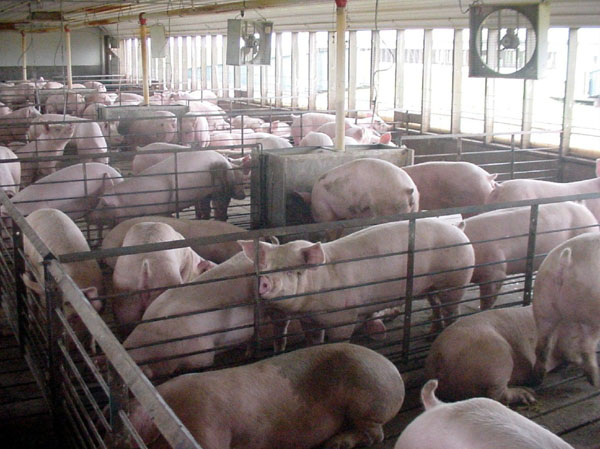
confined feeding lot - pigs | photo: Matthias M.
A recently published article shares that the FDA has once again failed to protect the public from corporate abuse.  Apparently in spite of it's own Guidance for Use (draft form published June 28, 2010) which was supposed to reduce the amount of antibiotics in the food chain, the FDA is now withdrawing legislation to mandate and reduce this usage.  I believe that this is because the FDA is too unwilling to do the right thing and would rather protect corporate interests (corporates need this overuse and abuse of antibiotics in order to be able to run their Confined Animal Feeding Operation (CAFO) or factory farms.

It is a disturbing fact that 70% of the antibiotic use in this country is used by the agriculture industry for food animals.  Not because the animals are already sick, but to keep them from getting sick due to the way they are raised; in unhealthy, high intensity settings.  Unfortunately this means that when you consume conventionally raised animal products, meat, dairy, and eggs, you are getting a dose of antibiotics.  Just a dose, not a full course.

As many of you know, when you are prescribed antibiotics by your doctor it is important that you finish the course.  This is to make sure that all of the negative bacteria that you are trying to wipe out don't survive and learn to become resistant.  Repeated minor doses of antibiotics teach bacteria how to grow stronger against them.  Emerging evidence indicates that this overuse of antibiotics is behind the increase of antibiotic resistant bacteria such as MRSA.

According to information about the FDA found at the Natural Resources Defense Council (NRDC), "The agency has known for more than 30 years that mixing human antibiotics into animal feed poses a risk to human health. It first confirmed the connection back in 1977."  They have filed a lawsuit in conjunction with the Center for Science in the Public Interest (CSPI), Food Animal Concerns Trust (FACT), Public Citizen, and Union of Concerned Scientists (UCS),  to try to get the FDA to follow through on it's own recommendations.

This is a situation that bears watching.  We can only hope that the FDA will come to it's senses and follow the lead of the European Union which banned the use of antibiotics for growth purposes as far back as 2006.  Until such time as this situation is corrected the only way to avoid ingesting animal products with antibiotics in them is to purchase organic (which is legislated to be antibiotic free) or you can try natural. The "natural" food label is not regulated or legislated however many manufacturers of products bearing this label do share on the packaging that they do not use antibiotics, hormones and preservatives.  Read the label.

Monday, November 28, 2011

do you know what's in your food?

image from: gmo-journal.com
I've been writing more about Genetically Modified (GM - also referred to as GMO or GE) foods lately.  Part of it is because the problem seems to be getting worse.  I am concerned that there is still no labeling required in this country.  According to this article from the San Francisco Chronicle 93 percent of Americans polled want their food labeled.  They want the right to know.  But it's still not happening.  Why?  Because it's bad for business.

I'm reminded of the fight over Recombinant Bovine Growth Hormone (rBGH) when the dairy industry fought like mad to stop farmers from labeling their milk as free of this harmful additive hormone which is not healthy for cows or humans.  The farmers prevailed in that they were allowed to label their products as being rBGH-free but were forced to put a statement on their product that there was no difference between dairy from cows treated with or without rBGH.  Science has since proved them wrong and we now know that rBGH increases Insulin Growth Factor 1 (IGF-1), decreases nutrition in the milk, increases mastitis in the cows (requiring antibiotics which we ingest because they don't stop milking the cows while they are giving them antibiotics), and decreased fertility in cows.  That's obviously a problem for the cows, if they can't be bred, or "freshened" in dairy parlance, they can't be milked and therefore are no longer useful.  If  rBGH causes infertility in cows (apparently studies have showed a reduction of as much as 40%), what does it do to the people who drink the milk?

We are the only industrialized nation, to my knowledge, that still allows this harmful chemical in our food.  Europe, Canada, Australia, and Japan, among others, have all banned it's use.  Purchasing dairy products labeled rBGH-free or organic is the only way to avoid this chemical.

But with GM foods it's a completely different thing.  Yes, purchasing organic is one way to avoid it, but no GM foods are labeled, not everything is available organic, and it's not financially feasible to purchase everything organic (at least not in our house).  You would be amazed at how far GM products have crept into our food supply.  We deserve the right to know what is in our food.  I believe that corporate interests and profits should not supersede the right to choose clean food.

I also wonder what it says when the employees of the company that makes most of the GM foods, Monsanto, won't eat it, demanding GM free foods in their cafeteria?  If they won't eat it why should you?

California is, potentially, about to become the first state to require mandatory GM labeling.  With 80 percent of those polled in California supporting this initiative I am hopeful that they will win.  Striking a blow against these modified foods and their manufacturers.  I'm also hopeful that this will be the first of a steamroller effect across the country.

To stay informed about this issue you can follow along on the blog as well as at Organic Consumers.

Monday, May 2, 2011

your right to choose

I just finished attending the annual conference of the National Association of Nutrition Professionals (NANP), held in San Francisco, CA,  where I met up with many wonderful "nutrition nerds", learned an amazing amount of information, and enjoyed fabulous food.  The NANP is the premier organization within the U.S. guiding standards for holistic nutrition.  Part of the requirement for professional membership is the continuation of our education, whether through conferences or other sources, we are all committed lifelong learners.

When I work with a client in my capacity as a Certified Nutrition Educator I am always careful to let them know that I am not a doctor.  I do not diagnose anything, I do not treat anything.  I do, however, know a lot about food and it's effects on the body; I am always engaged in learning more so that I can teach my clients how to meet the needs of their bio-individual bodies.

Along with all of the amazing and exciting information about nutrigenomics, epigenetics, and more I was shocked to learn about pending legislation in the State of California.  Under pressure from the American Dietetic Association, California is considering Assembly Bill 575.  As I understand it this Bill, if it passes, would mean that without ADA credentials, non-Dieticians would not be allowed to practice any form of nutritional therapy.

There are several problems with this legislation as I see it:

1.  Dieticians and Nutrition Professionals do different things.  Most Dieticians work in clinical settings, offering acute care.  Nutrition Professionals tend to work with clients from a more holistic point of view, providing education and support for chronic health issues.  There is a much needed and valuable use for Dieticians, but I believe what they do is frequently different from Nutrition Professionals and therefore we need both.

2.  The ADA has several major corporation such as Coca Cola, Pepsi, Mars, and Hershey on their board.  I do not believe they are unbiased against the suggestions and education offered by many holistic health professionals which in turn potentially impacts their products.

3.  This type of legislation could potentially prove devastating to a client's ability to seek integrative health care.  It would remove the right of choice.

California is not the only place where this is happening.  Similar legislation is being considered in Nevada, New York, and New Jersey.

I was horrified to learn at the conference that one of my heros in the nutrition world, Dr. Liz Lipski, has been issued a Cease and Desist order in the State of North Carolina and is no longer allowed to practice. This is a woman who holds a Ph.D. in Clinical Nutrition, an M.S. in Nutrition, is credentialed by two different boards, is a respected faculty member at several different universities and institutes, and has published a number of books.  However she has been deemed by the ADA as unqualified.  According to information found on her website someone with a BA in Dietetics, 6 nutrition courses, and no further experience is more qualified than she is from the ADA perspective.

I find that to be simply unbelievable and quite frankly disturbing.  As I mentioned above, there is a need for both.  This is not an either or issue.  Unfortunately I believe it is corporate bullying on the part of the ADA and possibly some members of it's board.  I also believe that the public has a right to choose.

This issue is on-going and likely to change rapidly.  If you live in one of the affected states I urge you to write to your Representatives and let them know that as a consumer and a constituent you are asking them to protect your right to choose.  Ask them to consider the position of the State of Colorado which in 2007 decided that this type of licensing did not meet the needs of it's citizens (letter found here).  If you do not live in one of the currently affected states it is important to be mindful that the situation could change.  Additionally there may be other action items that can be taken down the road so keep your eye out for further news and legislation.