Showing posts with label gmo. Show all posts

Monday, January 21, 2013

on my mind monday 01.21.13

It's never the same two weeks in a row.  A collection of what I find interesting in the world of food, nutrition, and holistic health.  Here's what's on my mind.

Eating a fatty diet may reduce sperm count - the study mentioned in this article does not show a definitive correlation, but a probable one.  However, of more interest to me is the fact that saturated fats are, once again, being vilified.  Saturated fat in excess is indeed not a healthy choice.  However, it is required for, among other things, hormone production, so curbing saturated fat intake to excess is also not healthy.  Of only minor mention in the article but, I believe, more significance, is the impact that obesity has on sperm health.  Male obesity has risen dramatically over the past three decades and has been accompanied by an increase in male infertility.  This is an issue that needs to be more directly addressed for those who wish to have children.

Artificial colors in medications can trigger hyperactivity - When I work with clients I encourage them to remove artificial colors from their diets.  These petrochemical-based substances do not belong in our diet or our bodies.  There are many studies which support this.  One major challenge, however, is that while you can choose foods, toothpaste, and personal care products which do not have color in them, you cannot control medications as easily.  And any artificial color that goes into the body can have an effect.  As I wrote about over a year ago in this article on color-free supplements, it is healthier to have color-free choices.  My hope is that eventually manufacturers will either choose plant-based color options, offer color-free options, or find a different way to identify medications that does not rely on petrochemicals.

Vitamin K the supplement of 2013? - I get really upset when the news claims a particular food, superfood, or supplement is the "it" item of the year.  Unfortunately in this country we have a habit of thinking that if a little bit is good a lot must be better.  Witness what happened with soy...it was noted that Asians, who eat more soy, have less incidence of certain illnesses.  So Americans added soy to their diet in huge measure.  Soy milk, soy cheese, soy meat, soy ice cream, the list goes on.  The problem is that we eat more unfermented soy than the Asians do, we eat genetically modified soy, and we're not responsible about how we add this highly phyto-estrogenic, goitrogenic substance to our diet. Adding vitamin K through food is not a bad thing, it can help to ensure that we have enough in our diet.  Found in dark leafy greens it's a good thing to add to the diet.  But to start supplementing without knowing whether you need it or not is not a good choice  While it is not known to be toxic, consuming too much has been reported to cause tingling or numbness in the hands and feet.  So by all means add dark leafy greens to your diet.  However if you are considering supplementing because it's the big thing of the year, consider testing your micronutrient status first to see if you really need it.

India's Packaged Food To Have GM Label - I'm so happy to see labeling of GMOs.  I hope that it will grow beyond just packaged foods and eventually include fresh foods as well as meat, dairy, and eggs.  After all, if the animals are fed GMOs the products we get from them are also GMO.

This video about food waste from the BBC


highlights just how much food is wasted in developed countries.  Some of it is due to confusion about labeling but some is due to carelessness.  Given the high number of people who don't have enough to eat in these countries, let alone the rest of the world, this is a major issue.  If we continue to think there's not enough food we continue to pave the way for GMO foods which, as is becoming increasingly clear, does not provide an appropriate answer.

Like these on my mind monday posts?
"Like" me on Facebook too for more information
and news you can use.

photo: mconnors

Monday, January 7, 2013

on my mind monday 01.07.13


It's never the same two weeks in a row.  A collection of what I find interesting in the world of food, nutrition, and holistic health.  Here's what's on my mind.

FDA begins implementing sweeping food-safety law - It's about time.  While I do believe that we need to have better measures in place to protect the safety of our food I will also say that I'm concerned that many larger food producers will still push for self-monitoring.  And I'm not convinced that the government is able to properly monitor our food system.  But changes are coming and I remain hopeful that this will be a positive thing overall.

Washington State eyes labeling GMO - Ready to be filed this week, it's an initiative to label GMO foods.  Also Prop 37 did not pass it opened the eyes of a lot of consumers and got them thinking about what's really in their food.  With around more than 100,000 more signatures than required to send the initiative to the Legislature this measure should be certified by the end of the month, starting the legal process to bring it in front of the voters.  I'm looking forward to watching this and hope that Washington can become the first state to make this happen.

Another hospital banning McDonald's - It's about time.

Gazpacho could help lower blood pressure -  given that it's made from whole foods which are known to have a wide variety of health benefits I wouldn't be surprised if further study proves this to be true.  In any event it's certainly a fabulous way to get a healthy serving of vegetables.  Here's my favorite gazpacho recipe for those willing to drink cold soup during the cold months.

B vitamins may boost colorectal health - B vitamins are so important to our health across a spectrum that includes stress, sleep, the immune system and more.  Now it turns out that they may have a benefit for colorectal health as well.  Studies need to continue however in the meantime it never hurts to continue to eat foods rich in B vitamins.  High levels of B6 can be found in tuna, beef and poultry.  Riboflavin rich foods include venison (also a good source of B6) and yogurt.

Dandy Blend - Not a news article, but definitely something that is on my mind.  With the colder temperatures (yes even in Texas), I've begun to drink more Dandy Blend.  It's a delicious beverage that is an excellent substitute for coffee.  Rich and full bodied I make mine with goat's milk and sometimes for a little treat I top it off with a teaspoon of coconut milk ice cream.  Why is it on my mind?  I met with my editor, Donna, yesterday and made a cup for her.  She had never had it before and loved it.  She said, "This is my new favorite drink."  So I wanted to share, maybe it's your new favorite too.

Here's a fun video from Joy Bauer with information about hot sauce


Don't forget to like The Pantry Principle to get
news and information about what's really in your food.

photo: mconnors

Monday, December 24, 2012

on my mind monday 12.24.12

It's never the same two weeks in a row.  A collection of what I find interesting in the world of food, nutrition, and holistic health.  Here's what's on my mind.

Wangari Gardens - Yet another great example of community gardens growing out of unused space.  I love that it was started by a student who envisioned a way to bring a garden to  an area that was previously considered a food desert.  Overcoming bureaucratic red tape and a variety of setbacks what now exists is a beautiful community space.

Farmer's worried about GMO contamination?  USDA says "get insurance." - This article is eye opening on many levels.  Even more so than the issue of GMO contamination, which is huge, is that GMO's do not work.  As the article mentions, we are now breeding superweeds which are roundup resistant, having somehow, mysteriously (read with snark) picked up the trait from the plants which were bred to be roundup resistant.  This is in spite of the fact that Monsanto in the beginning assured farmers that resistance would not be a problem.  Looks like they were wrong on that count.  And if that issue were not bad enough it turns out that we are ruining, depleting, our earth to an unsustainable point by mining minerals needed to make chemical fertilizers.  Time to wake up and stop the chemical cocktail we are pouring on and in our food.

Are your kids eating too much salt? - If you buy package, processed foods, don't read the labels, and eat out frequently chances are you and your kids are getting far too much salt.  Learning to read the label is the first step to controlling in the home sodium intake.  Thinking about where and what you eat when you eat out is next.  For young kids 1,200 mg is considered the recommended limit but some foods can provide a whopping amount of your daily intake.  One example is a two ounce serving of pretzels which could provide up to 900 mg of sodium.  But don't go no sodium either, your body needs it for metabolic function as well as to manufacture digestive fluids.  Moderation, but not avoidance, is definitely the key when it comes to salt.

The year of the liver - Apparently 2013 will be the year that liver makes it's way back into the American diet.  This could be a good thing it's a good protein source that is also high in iron, riboflavin, vitamin A, and vitamin B12.  Soaking it in milk is one way to temper the flavor for those who are not used to it.  Made into pate it's delicious, but sauteed in onions it's also tasty.  The best choice is to choose liver from pasture raised animals as there is no exposure to GMOs, pesticides, chemicals, antibiotics, or added hormones.

C. Difficile sniffer dog - Those cute little beagles (and other breeds) are everywhere.  Not just roaming the airports in their working dog jackets sniffing out contraband produce, not just detecting diabetes and various types of cancer, but now also identifying cases of a bacterial infection that can be difficult to treat and which may spread rapidly if not contained.  C. difficile can overtake the intestinal environment causing severe pain, cramping, diarrhea and even ulcerations.  With the help of Cliff (there's apparently only one sniffer dog at the moment) detection is quicker and easier.

And this video shows the Minister for Public Health and Sanitation of Kenya at a public briefing.  Kenya has just banned all GMOs while they evaluate their safety.


Don't forget to "like" The Pantry Principle to stay up to date and 
get news and information about what's really in your food.

photo: mconnors

Monday, December 10, 2012

on my mind monday 12.10.12

It's never the same two weeks in a row.  A collection of what I find interesting in the world of food, nutrition, and holistic health.  Here's what's on my mind.

What's in that pork? - The answer is not great.  As I discuss in my forthcoming book, The Pantry Principle, more antibiotics are used in the food animal industry than are used for people.  The challenge is that now this overuse is causing antibiotic-resistant bacteria to appear in the meat.  Which means if you eat it, you may get infected with a bacteria which is resistant to antibiotics.  Not a good thing. While this is not something that will change easily it can and should be changed.  Consider starting with letting Trader Joe's know that you want them to carry antibiotic free pork.

Peru bans GMO Foods - This is a huge step forward in the fight against GMO.  Peru did not simply require GMO foods to be labeled; they banned all of them from the country for a ten year period of time.  This was done in an effort to prevent GMO contamination of native corn and potato species. While I'm not sure which foods are imported from Peru I do plan to find out and see how I might incorporate them into our pantry.

US diets not up to standard - We're not eating as well as we should.  In part because we are surrounded by large numbers of unhealthy foods and because so many bad ingredients are stuffed into our food.  There is something called the Standard American Diet, or SAD.  Unfortunately it is sad and if we continue to eat this way our health will continue to decline.

Boycott Brands - As many of you know Prop37, the initiative to label GMO foods in California was defeated.  They were outspend significantly by the parent companies of brands such as Cascadian Farm Organics, Horizon Organics, and Tostitos Organics.  While organic foods cannot, by law, include GMO ingredients, the parents companies do not want you to know what they are putting into everything else they produce.  But it's hard to know who owns what and how to avoid those brands.  I have some information in my book The Pantry Principle about this issue but the book isn't out yet.  In the meantime print out this wallet card and take it with you to the grocery store.

It's Channukah, the Jewish Festival of Lights.  Latkes, or potato pancakes, are a traditional food during this eight day period of time.  For those who have never made them before, here's an easy recipe.  I have one change which is that sometimes I will take 1/3 of the grated, pressed potatoes and blend them into a finer texture which I then mix in with the grated, pressed potatoes.  And for toppings, we prefer applesauce and sour cream.  It's delicious.


Don't forget to head on over to Facebook and "like" The Pantry Principle so you can stay in touch as I start posting healthy tips and information.

photo: mconnors

Tuesday, October 30, 2012

gmo: what you need to know

As election day draws nearer there is an enormous amount of attention being paid to what the voters will do at the polls.  California is in the forefront of the move to label GMOs in food.  Other states have considered it but as of yet none have actually passed such a bill.  The general thinking is that if one state passes this legislation manufacturers will be forced to change all of their labeling nationwide in order to not have to create two forms of packaging.

The battle has been heated and intense with both sides contributing money to try to reach out to California voters and garner their support.  The chain of food ownership has become startlingly clear as the Cornucopia Institute put together this infographic showing who contributed what to the campaign.  Consumers were truly able to see that although companies like Cascadian Farms Organic, Larabar, and Kashi have a reputation as being consumer friendly and producing clean products, they are in fact owned by major corporation such as Kellogg and General Mills.  These giant food producers have a vested interest in maintaining our state of ignorance and have contributed hundreds of thousands of dollars to try to convince consumers to vote against GMO labeling.

This is not just an issue that we face here in the US.  All over the world governments and consumers are rethinking the use of GMO.  Just last month Russia suspended the use of GMO corn after a controversial French study showed ill effects in lab animals.  This study has since been brought into question however many of the issues it raised are valid and warrant further study.

This is not, however, the first time that there have been issues with GMO corn.  Back in 2005 there was a German study which showed severe health effects and damage to the liver and kidneys causing the German government to call a halt to the use of the corn.  A 2009 study done in Austria showed that there was a link between GMO crops and a decline in human fertility.

In August of this year two Australia farmers began to travel around New Zealand educating farmers against GMO crops.  As is the case here in the US, those that do not want GMO crops have no recourse if their fields are "accidentally" contaminated.  However there is no way for them to protect against wind, flood, and animals carrying seed.  All of these are potential methods of contaminating crops.  Monsanto has a known reputation for suing farmers for theft if their fields become contaminated, even if this contamination is against the wishes of the farmer.  The only way to protect against GM is to keep it out of the country.

In this video (1.5 hours but worth watching) Jeffrey Smith, the Executive Director of the Institute for Responsible Technology talks about GMO crops and their effects.


You can also watch the movie The World According to Monsanto to learn more.


If you want to read further about GMOs consider the following books:
At this point it may be difficult to stop the spread of GMO crops.  I believe it should be stopped and I believe it should be eradicated to the best of our ability.  But even more importantly I believe that we should have the right to know what's really in our food.  I will be watching the election to see what happens in California.  I will be hoping that Californians lead the way in supporting our right to know what's in our food.

photo: faul

Tuesday, September 4, 2012

organic or conventional?

The news headlines are once again blaring headlines about no significant nutritional difference between conventional and organic produce.  At a base level that appears to be true.  Foods grown in similar soil will have similar nutritional benefits.  The plants are only able to get so much out of the soil.

However, and this is not disputed in the new but certainly seems to be minimized, the chemical residues are higher for conventionally grown produce.  This is because in order for food to be considered organic there is a standard which prohibits the use of a vast array of chemical fertilizers and pesticides.  That chemical burden on your body can be considerable.  This alone makes it worth purchasing organic, especially for the "dirty dozen," those fruits and vegetables most likely to be highly contaminated by pesticide residue.

There was a modest mention made of the fact that organic produce appears to be higher in antioxidants.  Since antioxidant value was not considered as part of the overall nutritional value of the food this appears to have been discarded as a strong reason to purchase organic.  There are, however, a growing number of studies which show that antioxidant value is highly beneficial for the body, especially when it comes to a wide number of diseases and health conditions.

Another important fact to consider, which the articles don't discuss, is that organic produce is not allowed to be genetically modified.  Given the number of genetically modified crops (and the growing number under application for approval) it makes sense to purchase organic in order to avoid that in your food.

And a final thought on this issue, which the articles tend to gloss over, is that meat and dairy products from organically fed animals (meaning the animals are not allowed to be given added hormones, antibiotics, and are not allowed to be fed genetically modified or pesticide laden foods) do have significant differences.  Organic animal production means the animals are not allowed to be given added hormones, antibiotics, and are not fed genetically modified or pesticide laden foods.  The antibiotic issue is an important one for animal products.  When we eat continual low level antibiotics it is bad for our overall health and can encourage bacteria to become anti-biotic resistant.

Organic dairy products are measurably higher in protein and beneficial fatty acids.  Eggs also have a better fatty acid profile.  Studies show that organic meat is lower in fat and has a better overall fatty acid profile making it a healthier choice for consumption than conventionally raised animals and animal products.

Ultimately the choice of what to eat and how to spend your grocery dollars is up to you.  But before you make those choices make sure you have all the facts, not just a scaled down "no nutritional difference" newsbyte.

Wednesday, August 1, 2012

the future of food - a review

The Future of Food 
Written and Directed by Deborah Koons Garcia
Cinema Libre Studio

Released in 2004 the subject matter of The Future of Food is not only still relevant but increasingly important. The film presents a very sobering and disturbing look at how un-labelled, patented, genetically modified (GM) foods have invaded the shelves of our grocery stores. We literally are surrounded by GM without knowing it because unlike Europe, Canada, and other places, there is no labeling requirement for GM.

Focusing heavily on the persecution by Monsanto of Canadian farmers, whose crops were contaminated when GM seed drifted onto their property, the film brings to light the heavy-handed, threatening tactics Monsanto employs to prosecute farmers for theft of patent even though the circumstances were not of the farmer's choosing, were beyond their control, and represents an end to their livelihood as they know it. The film also reveals a truly disturbing picture of the “revolving door” that exists between major agriculture corporations (Big Ag) and the United States Government which virtually assures the hands-off policy that currently exists regarding GM crops. It also highlights the government's unwillingness to investigate and support bio-diversity and sustainable agriculture.

The film starkly points out “whoever owns the seed owns the food” while reminding us that these seeds are originally from nature. However their modification has created huge corporate profits (and greed) and a reduction in bio-diversity which could potentially lead to failures of epic proportions. Monsanto has even created a “suicide gene” which causes seed to terminate itself after one season, thereby blocking reproduction. Many environmental experts are shown expressing their concern should this terminator gene ever successfully cross-breed in the wild.

However it's not all bad news. The film also shows the resurgence of organic farmers and farmer's markets. Highlighting a a grass-roots grocery/consumer opposition to the attempts by Big Ag to control the food supply. After you watch it be sure to visit the Center for Food Safety, The Institute For Responsible Technology, and the Organic Consumers Association to learn more about what you can do to protect yourself and your family. Remember, your food choices are, and should be, up to you. 

The trailer is available on YouTube.


I originally wrote this for a private client. They are no longer publishing their newsletter and I am now able to share this review with you.


disclaimer: cmp.ly/5

Thursday, July 19, 2012

king corn, a review

King Corn 
Independent Lens
Written by Aaron Woolf, Curt Ellis, Ian Cheney,  and Jeffrey K. Miller
Directed by Aaron Woolf

 Did you know that more than 92,000,000 acres of corn were planted in 2007? Are you aware of the fact that in 2003 the USDA estimated that Americans ate an average of 73 pounds of corn sweetener per year? And it turns out an elemental isotope analysis of your hair may very well show that you are predominantly ingesting corn?

Corn has invaded our diet to startling levels. Aside from the obvious places like corn on the cob, corn syrup and corn starch, corn is also turned into fillers, modifiers, extenders and other ingredients that are used in everything from chips to cookies to beer and more. With almost 200 ingredients made from corn it's exceedingly difficult to avoid. Sadly this extends even further into our diet with cows, pigs, chickens, and now even farmed fish all being fed corn. What they eat becomes what you eat. Corn truly is pervasive in our diet.

This film, King Corn, was created by Ian Cheney and Curt Ellis in 2007. Recent college graduates motivated by America's bulging waistline they decided to try to grow an acre of corn and follow it all the way through it's process. Along the way they discovered just how much of what we eat comes from corn. Unfortunately corn has become a staple products of the American diet. Equally unfortunate it is a crop that brings with it numerous health problems. It is one of the most genetically modified crops, it is laden with pesticides, and it is a highly acidic food.  Corn is also not a profitable crop; not, that is, unless our tax dollars are brought into the equation and used to subsidize greater and greater amounts of corn being grown across the country.

In 2005 corn subsidies totaled more than $5 billion, enough to keep the corn empire rolling on and on and on.  These subsidies are what keep the junk food cheap, what keeps the corn coming in our diet.  It's also what encourages more and more acreage to be turned over into corn crops every year.


The trailer is available on YouTube.


King Corn is an amusing yet eye-opening look at just how much corn impacts our food supply. If you look at the list of ingredients that corn is transformed into such as artificial flavorings, artificial sweeteners, crystalline fructose, potassium gluconate and more, you'll realize just how difficult it is to avoid. In order to understand the impact of corn on our country, our agriculture infrastructure and our waist-lines, King Corn is a movie that you don't want to miss.

I originally wrote this for a private client. They are no longer publishing their newsletter and I am now able to share this review with you.


disclaimer: cmp.ly/5

Monday, April 30, 2012

on my mind monday 4.30.12

news | photo: mconnors
It's never the same two weeks in a row.  A collection of what I find interesting in health, nutrition, and holistic living.  Read what's on my mind.

Beef Cattle Become Behemoths - Antibiotics are not the only dangerous thing being fed to our livestock (dangerous because the overuse has negative physical effects for us such as helping to breed disease resistant bacteria).  Many conventional farms also feed animals hormones and other drugs to make them grow faster, grow fatter, and push their development all in the name of profit.  Many countries around the world, such as those in the European Union, do not allow this because of concerns about it's effect on the people that eat the meat from treated animals.  When that animal is slaughtered all the hormones and drugs do not go away, they stay in the meat and the fat.  If you eat it you then are consuming those products as well.  Building " bovine Schwartzeneggers" is not in the best interest of anyone other than the company that sells these drugs.  Now it looks like in addition to co-opting medical schools with research dollars and propaganda, pharmaceutical companies are, and have been, doing the same with agricultural schools.  Don't get me wrong, there are many good pharmaceutical formulations and they can have great benefit.  I just don't believe that this type of drug oversale is an appropriate usage, nor do I believe it is healthy for the animal or for those that consume it.

Watermelon's Wild Cousins - A watermelon that grows in the desert?  And provides reasonable nutrition?  Who knew such a thing existed.  This article highlights the Tsamma melon which grows, amazingly enough, in the Kalahari in South Africa.  The description of use and nutrition in this family of melons highlights why we need agricultural diversity and not genetically modified commercially motivated mono-cropping.  This idea is further highlighted by a recent article I spotted about Vietnamese farmers changing melon crops due to drought conditions.  My take from reading the article is that they were choosing a different type of melon rather than a GMO melon; an agriculturally and environmentally positive choice.

Calm.com - A wonderful guided meditation site with fabulous audio/video presentations.  Two minutes that can lower your blood pressure, re-center you, and help you to feel better.


Feeding a city is something that we don't often think about. But as we move to cities our diet changes, demand for meat and dairy goes up. And there's food waste and food imbalance (larger and larger number of starving people as well as those that are overfed). This video highlights how food moves into a city and looks at ways to help solve some of the problems that cities face when it comes to their food.

Four Foods You Probably Waste - I bring this topic up a lot.  Food is more than just access to good, clean, nourishing products.  It's also about proper utilization of what we have.  That means not wasting it.  Even though rotting food can be thrown into a compost heap to be turned into beneficial compost, isn't it best to eat it?  After all, you paid for it.  Here's a few simple and delicious looking recipes to help you avoid throwing out some of the most commonly wasted foods.

What I'm Reading

Make The Bread, Buy The Butter - I picked up the copy at my local library.  By the top of the second page I was hooked.  I like her writing style, we think the same way, and I have already bookmarked several recipes to try.  I was most impressed with her bread which uses 3 1/2 cups of whey.  That's awesome.  I have lots of whey hanging around from straining yogurt; although I use it, I confess sometimes it gets fed to the dogs because I have too much.  I am occasionally tempted to make ricotta cheese from leftover whey.  The trick is you need 16 quarts of the stuff and if I tried to squeeze 16 quarts into my side-by-side refrigerator I'm pretty sure my family would be upset due to the lack of space for food.  And that 16 quarts of whey?  It yields less than 2 cups of ricotta.  I haven't gotten to that part of the book but I'm guessing she recommends buying it.  This bread however looks to be a great use for leftover whey.  And I'm planning a tea party just so I can make my own clotted cream.  I'm also looking forward to reading the rest of the book which is definitely on my "to buy" list.

disclaimer - cmp.ly/5


Monday, March 26, 2012

on my mind monday 3.26.12

newspaper | photo:  mconnors
It's never the same two weeks in a row.  This is my snapshot of what I find interesting.  Information about health, nutrition, and/or holistic living.  Here's what's on my mind.

Methyl iodide off the market (for now) - I've been following this topic since I first found out about it at the end of 2010.  I was highly dismayed when California approved it for use in agriculture and began phasing it in.  Upset enough that our family has not eaten any strawberries coming out of California (even organic) since it was approved.  I'm happy to say that the decision to use it has been reversed.  Apparently the company made a decision to stop using it "based on it's viability in the  U.S. marketplace."  That means people made enough noise that BigAg listened.  However I still have some concerns.  the words 'U.S. marketplace' worry me because now I wonder where else they plan to peddle their poison.  I also intend to keep an eye on this to see if the company plans to try to reintroduce methyl iodide down the road after they figure the noise has died down.  Unfortunately we consumers sometimes tend to have a very short memory span.  We need to make sure that we remember this chemical and always demand that it not be used on our food.

GMO Labeling Law Wins Backing In Connecticut - Another positive moment in the press.  Some legislators in Connecticut agree that consumers have the right to know what's in their food.  Nay sayers claim that it will be more expensive for manufacturers to create two sets of packaging, one for Connecticut and one for everyone else.  My response?  Just label the stuff.  With almost half the states in the nation considering similar legislation it is not going to be long before other states follow suit.  At which point everything might as well be labeled.   Given the recent press about GMO crops being responsible for the decline in Monarch butterfly populations I believe more people are going to join the anti-GMO cause.  The eventual aim, as far as I am concerned, is not just to label (although I believe that is very important) but to stop using this technology.  In some cases considerable damage has already been done but it is never to late to stop.

This Land Is Your Land - This Time Magazine article about Joel Salatin is a great read.  He has a point of view that challenges the system but, I feel, in a good way.  He wants people to take responsibility for their food.  To stop seeing conveniently shrink wrapped packages at the food store without thinking about how they got there.  To understand the cycle of agriculture; to think about the food chain and how we consume.  We need to care, really care, about our food, where it comes from, how it gets to us, and how it's treated along the way.

Must Have Gadgets For The Kitchen - this article made me laugh because I often find myself drooling over gadgets that are one-purpose only or next to unusable for my actual kitchen needs.  Over the years I have gotten better and pared down quite a bit.  Just recently I went from three spring form pans to one (seriously, I'm not sure why I had three, I have never in my life made three cheesecakes [or anything else that required a springform pan] at the same time).  I've decided this is the foodie version of people who drool when they walk into a well-stocked hardware store.  You just envision all sorts of possibilities when confronted with all those shiny new gadgets.  I do have some kitchen tools that I will never part with but they tend to be the mainstays rather than the oddities.  My favorites?  My top electric appliances include:  KitchenAid Mixer, Cuisinart Food Processor, Immersion Blender,  and my Crockpot.  My less-than-stellar purchases?  Sadly I've made a few of those in my life because I got excited about the possibility of something and then never kept up with it.  There was the krumkake maker which is fun but I just don't use it enough, the yogurt maker which went by the wayside when I discovered that I didn't really need it, and the seed sprouter -- same deal -- I didn't really need it.  What are some of your kitchen must can/can't live withouts?


How to Save Seeds - this is something that helps plant diversity and supports backyard agriculture.   I confess to not being consistent with this, I need to work at it a bit more.


Hungry For Change - this is the new movie made by the same folks that brought you Food Matters.  For a limited time only (until March 31, 2012) you can watch a free online preview.  Definitely worth watching.  This movie talks about why so many foods are so addictive and how this is causing us to be overfed and undernourished.

disclaimer: cmp.ly/5

Monday, January 23, 2012

on my mind monday

newspaper | photo: mconnors
It's Monday and these are the news articles that have caught my attention from around the web:

A look at the $175 in your compost - That's how much many Americans throw our per month in food.  Most of it probably goes straight to the landfill not to a compost pile.  Wherever it goes, however, is a huge waste of food and resources.  We work hard at our house to make good use of leftovers, to plan what I call sequential eating, and menu planning.  This idea of not wasting food ties in with what Jonathan Bloom has been promoting for a while through his book, American Wasteland, and his Wasted Food blog.  Given the rising cost of food, it makes even more sense to think about what we're eating and how much we're buying.

Walnuts Are Drugs - Says FDA - seriously?  This is just ridiculous.  There are large numbers of scientific studies showing the health benefits of walnuts but apparently this is not good enough for the FDA.  It kind of makes me wonder how oats managed to get their approval for their ability to lower cholesterol (which they do.  There are studies to this effect and yet oat producers are not being told they cannot use those studies).  I have no problem with stopping unvalidated health claims, but where there is evidence that shows the healthful benefits why is the FDA stopping them?  Of course this is the same agency that told the cherry industry that they couldn't promote the healthful benefits of cherries, even with USDA funded studies that showed exactly what the producers were claiming.  Obviously there is a huge conflict of interest between food and drugs.

Fruits and Veggies Challenge - ever since reading last week about the sad fact that the USDA is not going to use the clever videos promoting fruit and vegetables they received in response to their contest, I have been working my way through watching the videos.  They're all good, one I like a lot is the Fruit Veggie Swag video.  I find it ridiculous that the USDA has received some wonderful replies that clearly promote eating more fruits and veggies and they won't use them.  I would much rather watch these than an over-hyped unhealthy fast food ad.

Just Label It - This link takes you to a video by Robert Kenner, the filmmaker who made Food Inc.  I am a huge proponent of food labeling for all sorts of reasons.  I am very much pro-label for GMO and believe we all have a right to know what's in our food.  The website also allows you to tell FDA Commissioner Hamburg how you feel about this issue.


disclosure: cmp.ly5

Monday, November 28, 2011

do you know what's in your food?

image from: gmo-journal.com
I've been writing more about Genetically Modified (GM - also referred to as GMO or GE) foods lately.  Part of it is because the problem seems to be getting worse.  I am concerned that there is still no labeling required in this country.  According to this article from the San Francisco Chronicle 93 percent of Americans polled want their food labeled.  They want the right to know.  But it's still not happening.  Why?  Because it's bad for business.

I'm reminded of the fight over Recombinant Bovine Growth Hormone (rBGH) when the dairy industry fought like mad to stop farmers from labeling their milk as free of this harmful additive hormone which is not healthy for cows or humans.  The farmers prevailed in that they were allowed to label their products as being rBGH-free but were forced to put a statement on their product that there was no difference between dairy from cows treated with or without rBGH.  Science has since proved them wrong and we now know that rBGH increases Insulin Growth Factor 1 (IGF-1), decreases nutrition in the milk, increases mastitis in the cows (requiring antibiotics which we ingest because they don't stop milking the cows while they are giving them antibiotics), and decreased fertility in cows.  That's obviously a problem for the cows, if they can't be bred, or "freshened" in dairy parlance, they can't be milked and therefore are no longer useful.  If  rBGH causes infertility in cows (apparently studies have showed a reduction of as much as 40%), what does it do to the people who drink the milk?

We are the only industrialized nation, to my knowledge, that still allows this harmful chemical in our food.  Europe, Canada, Australia, and Japan, among others, have all banned it's use.  Purchasing dairy products labeled rBGH-free or organic is the only way to avoid this chemical.

But with GM foods it's a completely different thing.  Yes, purchasing organic is one way to avoid it, but no GM foods are labeled, not everything is available organic, and it's not financially feasible to purchase everything organic (at least not in our house).  You would be amazed at how far GM products have crept into our food supply.  We deserve the right to know what is in our food.  I believe that corporate interests and profits should not supersede the right to choose clean food.

I also wonder what it says when the employees of the company that makes most of the GM foods, Monsanto, won't eat it, demanding GM free foods in their cafeteria?  If they won't eat it why should you?

California is, potentially, about to become the first state to require mandatory GM labeling.  With 80 percent of those polled in California supporting this initiative I am hopeful that they will win.  Striking a blow against these modified foods and their manufacturers.  I'm also hopeful that this will be the first of a steamroller effect across the country.

To stay informed about this issue you can follow along on the blog as well as at Organic Consumers.

Tuesday, October 18, 2011

aquaculture

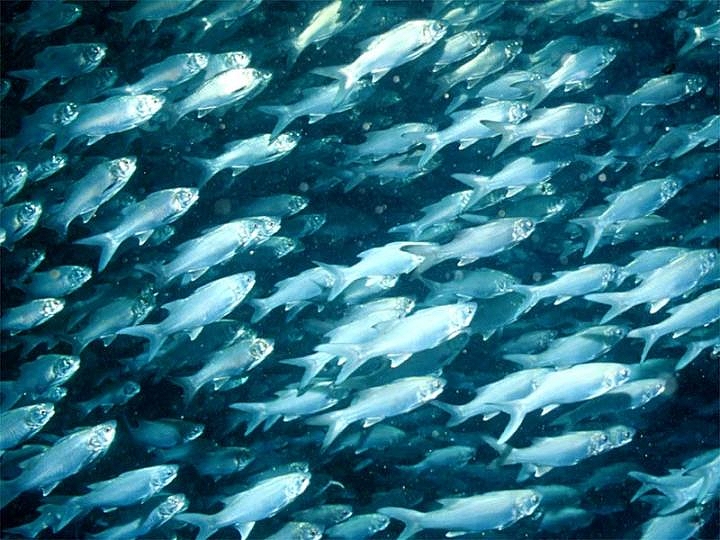
Pacific threadfins in cage | photo: Haplochromis
A recent article on NPR spoke about some of the challenges facing the idea of acquaculture - in other words, farming fish.  As our appetite for fish grows it creates a market for those who want to sell it.  However producers want to sell their product the fastest, most efficient way possible at the highest possible profit.  That means starting to tinker with the food chain.

Leaving aside the issue of the horror of GMO fish here are some objections to what appears to be happening in aquaculture.  It is important to start by pointing out that this is not to oppose sustainable aquaculture;  where fish are grown in an environment that allows them to flourish symbiotically with plants, insects, other fish and aquatic life.  The objection is to the concept of huge aqua-farms; the marine equivalent of confined feedlot operations for meat animals.  The animals are fed the cheapest, most efficient product to make them get fat faster so they can be sold quickly thereby increasing profit.  No real effort is made to raise the animal humanely or sustainably, just profitably.
  1. A direct quote from the article says, "A salmon gets more nutrients from a fish in the wild than it would eating something else."  Well that certainly makes sense.  So why would we want to feed them anything else?
  2. "[Scientists] are looking into new fish feed using renewable sources, such as biofuel co-products, poultry by-products, soybeans and so on."  Excuse me?  First, go back and read statement one above.  Then stop and think about what this says.  Biofuel co-products?  These are already fed to cattle contributing to their ill health.  And when they try to feed it to pigs the pigs don't like it.  Poultry by-products?  As far as I know poultry is not fish and I do not believe that fish should eat poultry guts, bones, skin, and feathers all mulched up into some sort of gloppy muck and then dried into pellets.  And the concept of feeding animals not fit for human consumption to other animals makes no sense either if the animal you are feeding it to will eventually be consumed. Soybeans?  We eat too many of them as it is in this country and the vast majority of what we eat is contaminated by GMO.  This doesn't even begin to take into consideration those people who are allergic to soy.  They may quite possibly now be allergic to farmed fish which I'm sure is not going to be labeled 'this fish was fed soy.'  And so on is another statement that bothers me; it is such a blanket, open ended concept that there's no telling what they'll decide to feed the fish.  As long as it's cheap and makes profit I am sure it will somehow be deemed appropriate to feed to the fish.
  3. "One of the challenges [they] face is getting a fish to eat something unfamiliar." Then why do it?  I don't think it's healthy for the fish.  And if it's not healthy for the fish, ultimately it will not be healthy for us.  There is lots of evidence showing that grass fed is healthier both for cows that are raised that way and for those who eat those cows.  But in this country we persist in raising corn-fed beef, creating unhealthy fatty cows that we then slaughter and eat.  Now we want to do this with fish which is touted as a heart-healthy food?  I do not believe it will be as healthy a food after it has been force fed an unnatural diet.
If you eat seafood you want to print out a copy of the Seafood Watch created by the Monterey Bay Aquarium; it lets you know which fish were raised in an environmentally friendly manner.


Sunday, October 16, 2011

world food day

genetically modified food
Today, October 16, is World Food Day.  There are many issues that can be related to our food and it's relationship to our health.  The biggest one at the moment is that of Genetically Modified Organisms (GMO).

For many years a controversy has raged about GMO.  I will admit that I am not impartial on this issue and I stand firmly opposed to the idea of GMO foods.  I do not believe we need them, I do not believe they are harmless to the environment, and I do not believe they are healthy for us.

However, leaving all of that aside, what I want to bring to your attention on World Food Day is that, for those of us living in the United States, we do not know if our food contains GMOs.  The only way to avoid them is to purchase organic products for those items that are most likely to be contaminated.  Currently the most likely contaminated foods are corn, canola, soy, cotton, alfalfa, papaya, sugar (both cane and beet sugars), and zucchini.  Currently coming to market are GMO rice, and sweet peppers.  There is also serious talk about a GMO fish and GMO apples.  Purchasing organic varieties of these foods is currently the only way to avoid GMO products.  But it extends beyond those products.  Any animal that is fed corn or alfalfa, unless it is organically raised, is in all likelihood being feed GMO versions.  That would include beef, chicken, and pork.  Any products that come from GMO-fed animals is contaminated with GMO, such as milk and eggs.  It can get very difficult to stay on top of what is being added to our food chain without our permission.

At the very least I believe we all have a right to know what is in our food.  For companies to be required to disclose the presence of GMO in their products.  At the present time there is no such requirement.  Many other countries around the world prohibit or label GMO foods, and I feel that the US should do the same. There is currently a petition circulating to let the FDA know that people want this label.  It's an important step toward preserving control over our food and our food choices.  I've signed it and I hope you will consider doing the same http://justlabelit.org/takeaction.

Saturday, October 9, 2010

organic beef giveaway

Rocky Mountain Organic Meats
When I teach classes helping folks learn how to make good healthy choices for their diet, organic is at the top of the list.  While I certainly understand that many of us cannot afford to eat 100% organic (I know I can't) there are ways to make sure that you are making the best possible choices.  Organic dairy and organic meat are at the very top of my list.

Organic standards are defined by the USDA and require certification to ensure that producers are meeting the standards set forth in the National Organic Program.  Organically raised animals are not given any hormones, antibiotics, medications to encourage growth, or genetically modified feed.  They are also allowed access to the outdoors on pesticide free grasslands and not placed into Concentrated Animal Feeding Operations (CAFO).

When it comes to dairy and beef products grass-fed is the best.  Why?  The biggest reason is that cows are not meant to eat corn.  They are ruminant animals and will be healthier if they are allowed to graze.  Their healthier lives in turn create a healthier product.  Beef from grass-fed cows has been scientifically proven to be better for you.  A study published in the April 2010 Nutrition Journal shared the results of three decades of research comparing grain-fed and grass-fed cattle.  The grass-fed cattle produced beef that was higher in conjugated linoleic acid (CLA) and omega-3 fatty acids, higher vitamin A content and lower overall fat.     Grain-fed beef tended to have higher cholesterol elevating myristic and palmitic fatty acids.  Clearly, if you are going to eat beef you want the organic, grass-fed variety.

See those cows in that pretty picture up there?  They live in Heart Mountain, WY where they are being watched over by my new friend Rod at Rocky Mountain Organic Meats.  He's generously offering up 10 pounds of his finest grass-fed organic ground beef, for FREE!  It's an $85 value which includes shipping; all you have to do is join in the contest.  How do you join?  It's easy:

1.  Subscribe to the email feed for this blog (if you are already subscribed say so in the comments)
2.  Become a Fan of RockyMtnCuts or GrainsAndMore on Facebook (if you already are say so in the comments)
3.  Follow Rocky Mountain Organic Meats or GrainsAndMore on Twitter (if you already do say so in the comments)
4.  Mention or link to this giveaway on your blog or twitter feed (leave a comment to let me know where)

One entry allowed per method.  That gives you seven chances to win.  Contest is open until October 25, 2010, 12:00 p.m. CST.

Winner is kindly requested to share a picture and recipe made with the prize for posting back here on the blog.

Good luck!

P.S.  Want to stay in touch with Rod?  You can sign up for his newsletter and get the latest and greatest from Rocky Mountain.

Legal mumbo-jumbo (sorry, boring but necessary):


This giveaway is strictly meant to be entertainment, no express guarantees are provided here (although I'm sure Rod wants you to be a very satisfied customer).
The product is coming directly from Rocky Mountain Organic Meats, therefore Grains&More assumes no responsibility for shipping or product.
Odds of winning depend on the number of entries.
Any taxes are the responsibility of the winner.
Grains&More did not receive any financial compensation for this offer.

Monday, May 24, 2010

shopping guides

I just came across this detergent shopping guide from Organic Consumers and it's so important that I knew I had to pass it along.  It has a list of all of the soaps/detergents that use 1,4 dioxane, a known carcinogen that can cause a host of health problems.

This seemed like a good opportunity to pass along a couple of other good resources that are available online.

The Environmental Working Group Shopper's Guide to Pesticides

The Environmental Working Group Safety Guide to Children's Personal Care Products

The Environmental Working Group Shopper's Guide to Safer Sunscreen

The Food and Water Watch rBGH-free Dairy Guide (search by state)

The Non-GMO Shopping Guide

Thursday, July 30, 2009

is organic food better

I have had a number of people asking me what I think about a recent BBC article that claims that organic food is not as healthy as it claims to be.  I've been asked what I think about this and can it really be true.  There's a lot of buzz being generated about this at the moment, here's my take on it:

1.  The article addresses only the nutritional content of the food in question.  A friend of mine who is a farmer claims that if the study had looked at smaller, sustainably produced organic farms the result would be different than large industrial organic farms.  I'm not sure whether that is true or not but it certainly is worth investigating before deciding that there is no nutritional benefit to organic farming.

2.a.  The article does not address pesticides, chemicals and hormones.  A large part of the reason people purchase organic foodstuffs is because they don't want the chemicals come along with conventional farming methods.  As I've mentioned before, there is something called the Dirty Dozen.  These foods are the ones that pick up chemical residue most readily.  If you don't want to eat that you can find out which foods they are by downloading the Environmental Working Group's Shopping Guide.

2.b. Many people, myself included, do not believe that saturating the soil with pesticides, fungicides, chemical fertilizers and such is healthy for the earth.  So aside from not ingesting these things when you purchase organic you also do a good thing for the environment.  

2.c.  Organic farming methods are also better for the people who work on the farms.  According to  Toxic Free NC "Agricultural families are at very high risk for exposure to pesticides. Workers can inadvertently take toxic pesticide residues home on contaminated clothes, hair, and skin. Because most workers also live very close to the fields, they are also subject to pesticide drift at home. Once in the home, pesticide residues are very easily picked up by small children, who are especially sensitive to health damage from pesticide exposure.  Subjecting workers to hazardous pesticide exposure on the job puts both the workers and their families at risk for serious health consequences."  

3.  Part of the organic standard is more humane treatment of animals that are grown for food.  I believe that this is important.  You can read an article I wrote about organic milk.   Shouldn't the humane treatment of animals be part of our consciousness?  Aren't we evolved enough to not want these animals to live in discomfort before they provide for us?  I believe that we still have a distance to go before the system is where it should be concerning the treatment of farm workers and animals, but certainly the measures provided by organic standards are a solid beginning.

4.  Another part of the organic standard is that foodstuffs may not be Genetically Modified (GM).  Since the only way to ensure that something is not GM is to purchase organic this becomes an important distinction.  Read this article by the Institute for Food and Development Policy to learn more about some of the concerns about GM food.

In his book, "In Defense Of Food," Michael Pollan writes about how our diet has been hijacked by the theory of nutritionism.  That everything has to boil down to a perfect science of nutrition.  Unfortunately that falls far short of the mark and is not a complete answer.  This study falls firmly under the category of nutritionism, ignoring all other reasons to consider organics.  

So when friends and clients ask what I think about this I point out the thoughts above and say that my choices are based on more than just the nutrients in the food.  It's about the choice for no sewage in the fields, no chemicals, more humane treatment of animals, what I believe is better tasting food, and especially my desire to limit my exposure to GM food.


Wednesday, June 24, 2009

Food, Inc

This movie looks as if it will provide an interesting view of modern food production. Unfortunately it's not showing in my area. Looks like it's playing in Houston, hopefully there are a lot of opportunities for folks all over the country to see it.

Go to the official site to see if it's playing near you.

You can also go to the Whole Foods Blog to read their take on the movie and their food process.

I believe this is an important issue. Our processed food and the way we eat is making most of us sick. It's not healthy for us, our kids or our future. We need to care more about what we eat and make a choice to eat for health.

Wednesday, April 22, 2009

organic gardening

It's beginning to take off.  First we started with the White House Organic Garden

Now we have the People's Garden.

It seems like the concept of organic gardening is "taking off." Believe me, this is a good thing. Organically grown food has no pesticide residue because pesticides aren't used. Organic farming methods produce lower levels of pollution and conserve soil and water resources. Organic fruits and vegetables have more nutrients because the soil isn't depleted by use of chemical fertilizers. In my book these are all compelling reasons why organic needs to become the norm rather than the exception.

In one of the classes that I teach I tell people about the benefits of buying organic. I understand that for a lot of people it's a difficult decision and one that involves your wallet. One resource that I encourage them (and you) to take advantage of is the Environmental Working Group's Shopping Guide to Pesticides which tells you which are the 12 biggest pesticide laden fruits and vegetables and which are least likely to be affected. This printable guide can help you make better decisions at the grocery store.

Of course big agribusiness isn't too thrilled about public organic gardening but then again I wouldn't expect them to be. I do, however, expect this trend to continue; it's better for all of us, for the environment and for future generations.


Be well.

Monday, April 20, 2009

national zucchini bread day

April 24th is National Zucchini Bread Day.  I'm not sure why it is zucchini bread instead of just zucchini but I'm happy that at least zucchini is getting mentioned.

Here in Texas, as in many other places of the country, zucchini is starting to produce in abundance.  My uncle, who lives in California, claims that in the middle of the summer you need to drive around with your windows rolled up.  Otherwise when you stop at a traffic light grocery bags of zucchini are apt to come flying through the window.

Everyone who grows zucchini seems to fully understand the abundance of nature.  One tiny seed can produce a fruit that ranges in size from baby-pickles to dugout canoe.  But before we malign this wonderful fruit (and yes, zucchini is indeed a fruit, even though we treat it like a vegetable) let's look at how good it is for us.

Zucchini, sometimes also called courgette, is a type of squash from the Cucurbito pepo species; they can be green skinned or yellow skinned and are usually shaped like a cucumber, although there are some varieties that have different shapes. The species is believed to be native to the Americas and was brought to Europe during colonization.  Eventually, in Italy, there was a mutation that gave rise to the green skinned version that we usually refer to as zucchini today.  This variety was brought back to America by the Italian immigrants.

Zucchini are great for a lot of different things.  They are wonderful sliced and served straight up in a salad, as crudites or baked, stuffed, grilled, in soup or shredded and baked into dessert.  In addition to tasting great and being such a useful fruit what nutritional benefits can you find in zucchini?  To start with they are a great source of manganese which is an essential trace mineral.   Zucchini are also very high in vitamin C.  Manganese works with vitamin C to help detoxify the body among other health benefits.   They are also a good source of magnesium, Vitamin A, fiber, folate, potassium and phosphorus.  So to salute this fabulous fruit, and in honor of National Zucchini Bread Day, grab your favorite recipe and make a batch.

Unfortunately my research turned up the fact that two genetically modified (GM) strains of zucchini are currently approved in the US for cultivation and use as food.  Unless you are getting them from a trusted source or from your own garden you may want to purchase organic zucchini.

Be well.

photo courtesy of
Forest & Kim Starr